
We can't find the internet
Attempting to reconnect
Something went wrong!
Attempting to reconnect
What “Agent” Meant After I Stopped Guessing
What an agent is actually responsible for — an LLM with tools and skills in a loop, when a workflow is enough, and a learning order for software engineers entering agentic AI.
Part 1 of 4 · Next: context engineering →
I had already built a mental map of LLMs — tokens, context, tools, the usual levers. I still did not have a clear picture of what an agent is responsible for. The word showed up everywhere. The job description did not.
This post is that clarity, written for software engineers who are entering agentic AI the same way I did: not as ML researchers, but as people who ship systems and need a useful map.
It stands on its own. If you want the earlier foundation, I wrote a short LLM trilogy on basics, vocabulary, and tool calling. This series starts where that left off — on the agent path.
What I mean by agent now
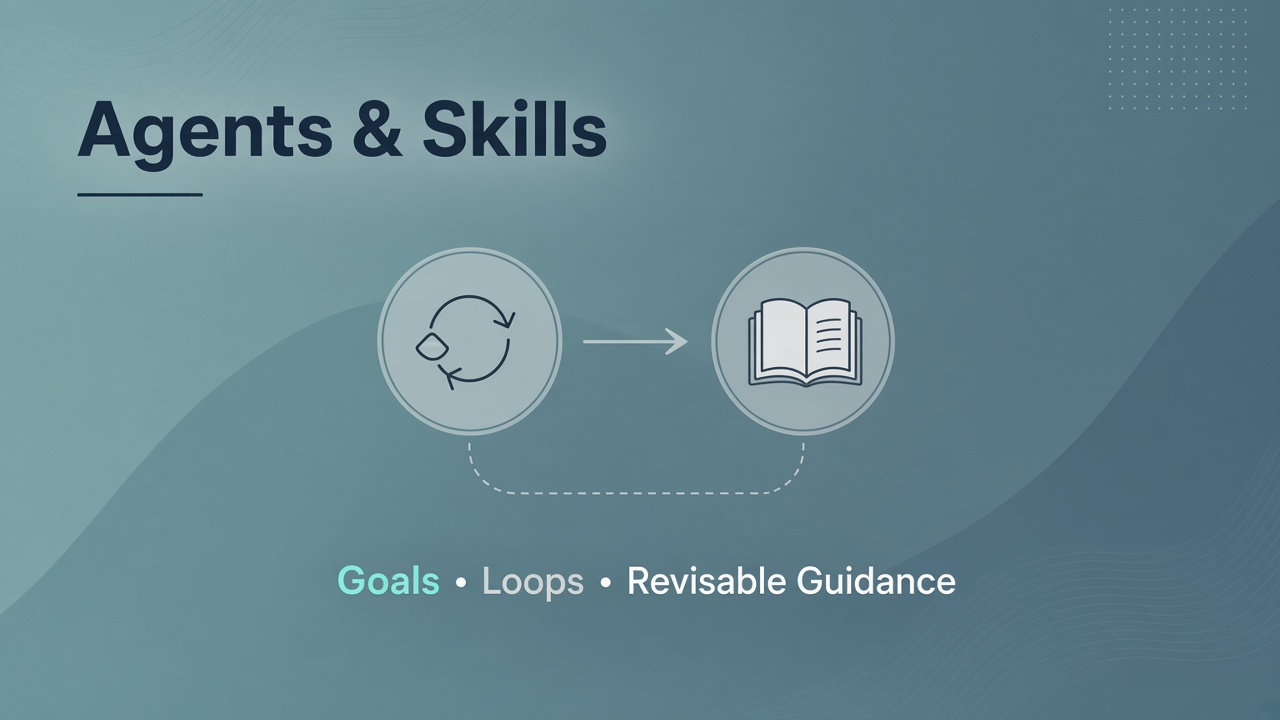
In plain terms, an agent is an LLM with tools and guidance in a loop, working toward a goal. The path is not fixed in advance. The model can choose steps, call capabilities, observe results, and continue until the goal is met or it stops.
That sounds simple. It was not what I pictured at first. I had a vague sense of “AI that does work,” without a sharp idea of tasks, responsibilities, or where the application’s judgment ends and the model’s begins.
Once I held that definition, a lot of hype compressed into ordinary engineering: orchestration, contracts, observability, and knowing when not to use an agent.
Workflows vs agents
Not every LLM-powered feature should be an agent.
| Workflows | Agents | |
|---|---|---|
| Control | Code (or a fixed graph) owns the path | The LLM directs tool use and next steps |
| Path | Known, orchestrated | Open-ended; adapts as results come in |
| Fit | Reliability and a clear sequence matter | The method must change with the situation |
When the path is known and you care about predictability, a workflow — prompt chaining, routing, parallel calls you combine in code — is often the honest design. When the path must adapt, an agent earns its keep.
The practical lesson for me: start from the business task. Do not start from “we should add agents.”
Skills: revisable guidance, not a frozen workflow
A skill is packaged guidance for a task — what good looks like and how to approach it — that an agent can follow and that you can revise as the work changes, without hard-coding a fixed workflow.
Skills matter on the agent path because real work is rarely a permanent checklist. Sources change. Quality bars change. Edge cases show up. If all of that is buried in one-off prompts or rigid code paths, you either freeze the process too early or you constantly rewrite orchestration.
That is how we approached company enrichment in our CRM. Enriching a company is not one API call. It can pull from the company website, LinkedIn, news, government sources, and more — and the method keeps changing as we learn what signals matter. A fixed workflow fought that reality. We solved it with skills: agents follow packaged guidance for the enrichment task, and we revise that guidance as the playbook improves, instead of hard-coding every source and step.
The lesson that stuck: when the task is open-ended and the playbook keeps evolving, skills let you keep agents useful without freezing the process too early.
Patterns worth knowing (as a map, not a course)
You will see the same design ideas under many names:
- Prompt chaining — sequence of LLM steps; output feeds the next
- Routing — classify, then send to the right path
- Parallelization — fan out calls, then combine
- Orchestrator–worker — plan, then execute subtasks
- Evaluator / reflection — produce, critique, improve
Treat these as a vocabulary for design reviews. You do not need to implement all of them to understand agents. You need to recognize when a problem is really a chain, a route, or a loop with tools.
Agent frameworks and SDKs exist as means: they help with tool loops, memory, guardrails, and orchestration. Collecting frameworks is not a learning path. Matching a small amount of autonomy to a real task is.
How I’d approach learning this as a software engineer
If I were advising another full-stack or product engineer:
- Start from the task, not from “build an agent.”
- Get clear on tools and context before multi-agent theater.
- Prefer small autonomy → observe behavior → add complexity only when something measurable improves.
- Learn skills as revisable task guidance when the method will change.
- Keep frameworks in their place: useful harnesses, not the curriculum.
Resist the urge to invent a cast of human-like “roles” on day one. Roles without a proven need are theater. Measure first; add structure when the work demands it.
What’s next
Clarity about agents and skills is necessary. It is not sufficient.
Reliability often fails for a quieter reason: everything the model sees — instructions, history, retrieved knowledge, available capabilities — is poorly chosen for the next step. That craft is context engineering.
- Post 2: Context engineering — everything the model sees.
- Post 3: RAG — grounding agents in your own datastore.
- Post 4: MCP — same system, operable from different agent harnesses.
These notes draw on agentic AI engineering study (for reference: The Complete Agentic AI Engineering Course on Udemy), shaped by building and using agent-facing product work.
Series
- What “Agent” Meant After I Stopped Guessing (this post)
- Everything the Model Sees (Context Engineering)
- Grounding Agents in Your Own Data (RAG)
- Same System, Different Agent Harnesses (MCP)